pixel

The Link Between JROTC and Character Development

May 21, 2015 | Leadership

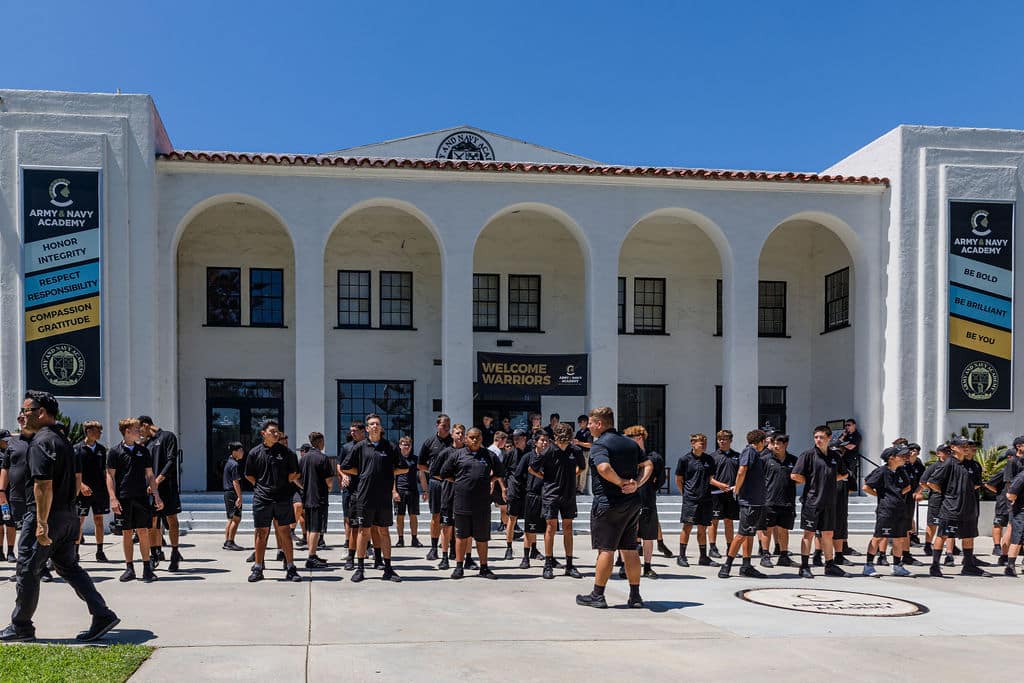
group of students in black uniforms

In recent years, character education has become a hot topic in the United States.  As the social and cultural landscape changes, the need for moral and value-based education increases.  Research has shown that JROTC programs are exceptionally effective in teaching character and having a positive, long-term impact on participants.


Character can be Taught

A study by Dr. Cletus R. Bulach concluded that good character is a quality can be taught.  Further, he found that JROTC programs are a particularly effective method for promoting character development.

To conduct his research, Dr. Bulach presented a survey to 477 students at a high school in Atlanta, GA.  277 of the students were in JROTC, the other 200 were not.  The survey asked students 96 questions based on 16 predetermined character traits, including aspects of Army and Navy Academy’s core values of honor, integrity, respect, responsibility, and compassion.

He found that there were significant differences between the two groups’ survey responses.  “JROTC students tended to agree with positive behaviors and disagree with negative behaviors” far more often than their non-JROTC counterparts.  He concluded that “the issue of whether character traits can be changed is no longer a question.  The JROTC students in this study came from the same community and population as the other students and their conduct on the behaviors associated with 16 character traits was superior.”

Army and Navy Academy places a strong emphasis on character education.  Character education is a key component of the Academy’s mission statement and also one of our pillars.  Our core values of honor, integrity, respect, responsibility, and compassion shape all interactions, both inside and outside the classroom.

A Curriculum for Life

Historically, JROTC programs were designed to prepare students for the military.  This is no longer the case.  Today, JROTC education “prepares students for responsible future leadership roles, while making them aware of individual rights, responsibilities, and privileges as American citizens.”  Emphasis is placed on personal responsibility, which in turn leads to community awareness and civic engagement.  Dr. Bulach describes this as “a life skills’ curriculum.”

This is the approach taken at Army and Navy Academy, where our mission is to educate and develop young men of good character.  The Academy curriculum includes classes on leadership and citizenship, preparing our cadets for the future and instilling values and the skills for academic achievement that make them ready for college and life beyond.

Why Does This Work?

First, a JROTC program offers a different degree of modeling behavior for students than other types of school programs.  The Academy’s JROTC instructors are former or retired military personnel, who not only teach character development, but also exhibit good character through their own actions and words.  The modeling of positive character traits is a key to teaching young men.

Additionally, the aspect of making an active choice to be a part of the program plays a role.  At Army and Navy Academy, commitment to attend is a major factor in determining admission.  Only students who are fully committed to attend are admitted to the Academy.  This gives a sense of belonging that is often absent from other schools, and creates a community where good character is encouraged and rewarded. Cadets know what is expected of them, and know that there are consequences to disregarding the Academy values.

Character Leads to Academic Achievement

Other studies have shown that there is a correlation between students with qualities associated with good character – self-discipline, cooperation with others, and persistence – and academic achievement.  Students with good character traits tend to ask more questions in the classroom, are harder working, and score higher on achievement tests.

This provides even greater evidence of the importance of character education.  The character-based curriculum at Army and Navy Academy improves our students’ academic success, leading to increased grade point averages and an impressive list of college acceptances.

The Army and Navy Experience

There is a clear relationship between academic success and character development, and the Academy’s focus on both of these aspects of education give cadets an advantage that can’t be found at other schools.  Our JROTC program develops students who are prepared for life in college and beyond, to become respected leaders in their communities.  The Army and Navy Academy experience truly allows cadets to reach their full potential as young men of good character.

References:

All quotes excerpted from: Bulach, C.R. (2002) A Comparison of Character Traits for JROTC Students versus Non-JROTC Students. Education.  122(3).  559-563.

Other resource: Citation: Huitt, W. (2004). Moral and character development. Educational Psychology Interactive. Valdosta, GA: Valdosta State University.

A practical leadership guide for boys and parents, built on structure, mentorship, and the daily choices that shape character

If you spend a few minutes with Major General Arthur Bartell (U.S. Army Retired), you’ll notice something right away. He is direct, calm, and deeply focused on people. Academy President Barry Shreiar sat down with General Bartell in a recent podcast episode to talk about what develops confident young men in a world that feels louder, faster, and more complicated than ever.

It was not a conversation about hype or shortcuts but about playing the long game. Boys become men through structure that becomes habit, habits that become lifestyle, and a lifestyle that becomes identity.

The conversation also served as a reminder that what ANA is building is bigger than school. It is an academy in the truest sense, a place designed to shape the whole person for life.

Key Takeaways

  • Structure is not the goal; it is the tool that helps boys build durable habits.
  • A boy’s confidence often grows from small, repeatable habits: eye contact, a firm handshake, showing up ready.
  • Mentorship matters most when it is consistent, honest, and respectful.
  • Consequences teach better than shame, and recovery from mistakes is a skill boys must practice.
  • Technology and AI are not going away, so boys need readiness, sequencing, and guardrails to work within this reality, not a denial of it.
  • Daily physical training is about more than fitness, it is a culture check for discipline.
  • ANA’s mission to forge virtuous young men is more relevant now than it has been in decades.

Why This Conversation Matters for Young People

General Bartell served 36 years in the U.S. Army. He entered at a pivotal moment, after the Vietnam War and during the rise of the military as an all-volunteer force. He lived the Cold War years, deployed during Desert Storm, served in the Global War on Terror era, and later commanded U.S. Army Cadet Command, overseeing ROTC and JROTC programs nationwide.

As a military child and later an army officer himself, Bartell spent his life moving frequently, and remarkably, his eight years serving as the president of Army and Navy Academy was the longest he had lived in one place.

That matters because it is how he is able to understand what ANA does so clearly. He knows what instability feels like and what leadership requires. He also knows why a values-driven environment is not a “nice extra,” it is a stabilizing force, especially for those in formative phases of life.

Lesson 1: Your Day Builds You, One Rep at a Time

One of the most practical stories Bartell shared in this episode was about physical fitness training and why, through it, character is revealed. 

General Bartell remembered a commanding general in the 10th Mountain Division who believed he could evaluate a unit simply by watching their morning physical training (PT) routine. This general would show up unannounced and watch how the unit formed up, how they carried themselves half-awake, followed instructions, and how they stayed together when it got uncomfortable. Afterwards, he would send a letter to the commanding officer, detailing what he observed went well and what needed work.

That story resonates with cadets because at ANA, PT is not just exercise; it is part of the culture.

  • It teaches boys to do hard things early, before excuses pile up.
  • It reinforces the idea that discipline is a skill, not a personality trait.
  • It creates a collective challenge, often uncomfortable, which becomes shared pride.

For boys, especially, this matters because the body is often the front door to the mind. Movement can regulate emotion. Exertion can reduce stress. Physical challenge can create clarity. General Bartell’s leadership point is simple: the little things show the truth. A unit’s character shows up in the morning. A boy’s character does, too.

“He used to say that he could tell everything about a unit by how they did their PT.”

– General Arthur Bartell

Lesson 2: Structure Is Not Control, It Is a Launchpad

Structure leads to habits, and habits lead to lifestyle.

ANA uses the military model because it provides a clear, boy-friendly structure. The point is not blind conformity but to reduce chaos by building consistency.

This is one reason families often see changes quickly in a boy who needs a reset. When the day has a rhythm, boys stop negotiating every step and instead start practicing steadiness.

Here is what that can look like, in real-life terms:

  • A uniform is structure. How a cadet wears it is a habit.
  • A handshake is structure. Eye contact is a habit.
  • A schedule is structure. Showing up ready is a habit.
  • A rule is structure. Owning choices is a habit.

Those habits become a lifestyle, and lifestyle becomes identity. Over time, boys stop “trying to be disciplined” and start recognizing themselves as disciplined. That shift is a major part of what parents want, even if they do not always describe it that way. They want their son to feel capable and to trust himself. Structure done well helps boys build that trust.

“We have a structure here and our structure leads to habits, and habits lead to a lifestyle.”

– Barry Shreiar, ANA President

Lesson 3: Consequences Teach Better Than Punishment

Boys will make mistakes, and many will test boundaries. Some of that is immaturity, some of that is wiring, but the simple truth is that boys often learn by doing, not by hearing.

General Bartell likes to reference a hot stove as an easy image to make his point. You can warn a boy not to touch a hot stove, but many still feel compelled to test that warning. That is not a moral failure. It is a developmental reality.  The key is what happens next.

  • Punishment says: you are the problem.
  • Consequence says: your choice has an outcome, now let’s learn and recover.

At ANA, the goal is not to crush a boy for a mistake but to build his ability to recover, make a new choice, and keep moving forward. This is a life skill, not just a school skill.

“I never liked this notion of punishment, so I would push this notion of the consequence.”

 – General Arthur Bartell

Practical Strategies for Parents and Educators: Consequences That Build Character

  • State the rule and the reason in one sentence.
  • Use predictable consequences, not emotional ones.
  • Keep your tone calm, even when your son is not calm.
  • Separate the boy from the behavior. Address what happened, not who he is.
  • Ask one reflective question after the consequence: What will you do differently next time?
  • Praise recovery. Boys need to learn that bouncing back is part of strength.

Lesson 4: Mentorship Is the Shortcut Boys Actually Need

Mentorship is repetitive, consistent, and sometimes feels inconvenient. It is a weekly phone call. It is the adult who is willing to say the hard thing, respectfully, and stay in the relationship.

Shreiar and General Bartell talked about General William Crouch, an ANA alumnus and former Vice Chief of Staff of the U.S. Army, who served the Academy as a board leader and mentor. In the Pentagon, he had a reputation for being intimidating. At the Academy, he was direct, but also deeply empathetic. For General Bartell, he became a grounding presence during his transition into school leadership.

This is exactly what boys need too. They need adults who:

  • tell the truth clearly
  • keep standards high
  • don’t withdraw when a boy struggles
  • model steadiness under pressure

That is how boys learn to lead themselves and later to lead others.

“He epitomized the word mentor. He was always brutally frank with me, but always respectful.”

 – General Arthur Bartell on General William Crouch

Lesson 5: In a Tech-Saturated World, Boys Need Readiness and Order

The episode turned toward one of the most urgent realities facing parents and schools: boys are receiving information out of sequence.

General Bartell mentions how early boys are gaining access to smartphones, and how unprepared they can be for the volume and intensity of what comes through that device. Shreiar extends the idea with a powerful analogy: kids are being handed advanced material before they have the basics.

AI adds another layer. The challenge is not simply academic integrity. The deeper issue is development. If a boy uses powerful tools before he understands fundamentals, he can lose the chance to build:

  • critical thinking
  • discernment
  • frustration tolerance
  • the ability to spot what does not make sense

In other words, he can lose the very muscles he will need to thrive. This is where virtue education becomes practical. Virtues like responsibility, integrity, and self-control are not abstract. They are the reason a boy chooses the hard work first, and the shortcut second.

“They’re not prepared. They’re not mature enough to understand the information that they have.”

  – Barry Shreiar, ANA President

Practical Strategies for Parents and Educators: Helping Boys Use Tech Without Losing Themselves

  • Teach in proper sequence: fundamentals first, tools second.
  • Create phone-free zones tied to purpose, like meals, homework start time, and bedtime.
  • Ask your son to explain his thinking out loud. This reveals gaps that tech can hide.
  • Teach a simple rule for AI: AI can assist your thinking, but it cannot replace your thinking.
  • Build “friction” into impulsive habits: charging phones outside bedrooms, app limits, or scheduled check-ins.
  • Model restraint yourself. Boys learn more from what they observe than what they are told.

ANA as a Living Lab for Virtue, Structure, and Growth

This conversation is a clear window into what ANA is designed to do. ANA is not trying to produce perfect boys. It is trying to shape capable young men who can handle life with steadiness and character.

That is why cadets practice the basics daily:

  • showing respect in small interactions
  • learning to recover after mistakes
  • building confidence through repetition
  • living inside a structure that becomes their self-discipline
  • being mentored by adults who stay consistent

General Bartell described something he noticed immediately after closing his talk to the Corps of Cadets earlier in the day: cadets making eye contact, giving a firm handshake, carrying themselves with confidence. Those are not small details. They are early signals of identity forming. This is what “forging virtuous young men for life” looks like in real time.

“These cadets are our credentials.”

 – General Arthur Bartell

What You Practice Becomes Who You Are

Cadets, here is the truth you may not want to hear, but later you will be glad you did.

You are building your future self right now, whether you mean to or not. Every morning is a vote. Every choice is a rep.

  • When you show up, you build reliability.
  • When you take correction without collapsing, you build resilience.
  • When you own a mistake and recover, you build integrity.
  • When you do the hard thing before the easy option, you build leadership.

You do not need to be perfect, just consistent. And if you are wondering whether this really matters, ask almost any alumnus. Many of them will tell you the same thing: for some, the light bulb may turn on later, but when it illuminates, that’s when the growth happens.

Final Takeaways

  • Structure is not about control; it is about building habits that last.
  • Consequences teach boys how life works, and recovery is part of strength.
  • Mentorship changes trajectories, especially when it is consistent and honest.
  • PT is a daily culture check for discipline, teamwork, and mental toughness.
  • Technology requires readiness and sequencing, not just rules.
  • Virtue is practical; it is the reason boys choose the hard right over the easy wrong.

Watch or listen to the full episode to hear these leadership lessons in General Bartell’s own words: https://youtu.be/85rNy2IJW0I